
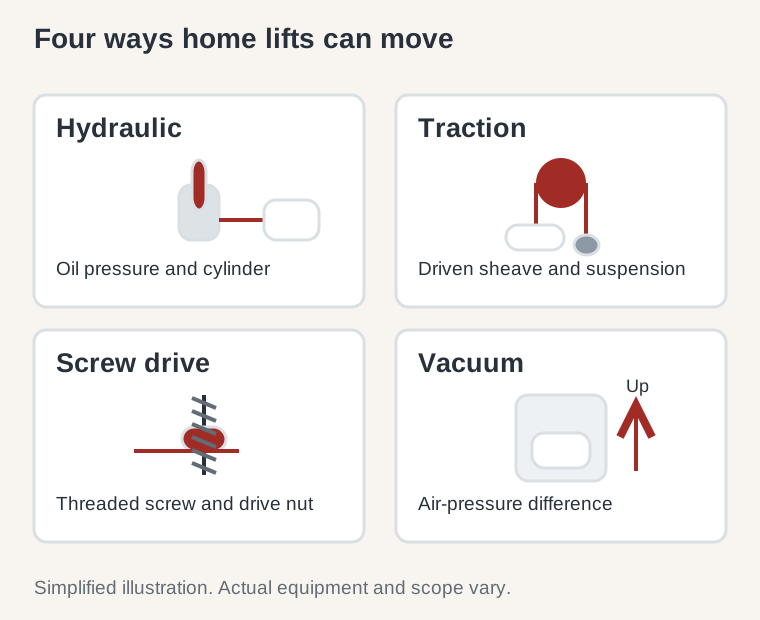
Home lifts can look similar while using different ways to move. Understanding the drive type helps you ask useful questions about an existing installation, a house purchase or future equipment choices.
This is an explanation of the main principles, not a claim that Hiteck installs or services every type. Confirm support for the particular make and model before arranging work.
Hydraulic home lifts
A hydraulic system uses an electric pump, oil and a cylinder to create lifting movement. The arrangement between the cylinder and car varies. The hydraulic lift explainer shows one simplified example.
For an existing home, ask where the equipment is located, which records are available and what maintenance the installed system requires. A general hydraulic label does not establish the dimensions, price or service programme.
Traction home lifts
A traction arrangement uses ropes or belts passing over a driven sheave, with a counterweight in common designs. Compact machinery may be arranged without a conventional separate machine room.
The traction guide explains the parts in plain language. Confirm the actual equipment layout and access requirements rather than assuming all traction home lifts need the same building space.
Screw-drive lifts
A screw-drive system uses a threaded screw and a driven nut to produce vertical movement. In a common arrangement, the nut rotates around a fixed screw and moves with the lifting assembly. Exact designs differ.
Ask whether the product is a platform or cabin arrangement, how users operate it and what its documentation says about permitted use. Its appearance alone does not establish its classification or maintenance requirements.
Vacuum or pneumatic lifts
Pneumatic designs use an air-pressure difference to produce lifting movement within a tube. The installed system controls the pressure and stopping arrangements. This principle does not mean there are no mechanical parts or maintenance requirements.
Check the model's capacity, access, support arrangements and service instructions. Avoid broad statements that every vacuum lift has the same installation requirements or running costs.
The drive type is only one comparison
For a new purchase or retrofit, useful questions include:
- What capacity, travel and stops does the actual model provide?
- Does the layout suit the intended users and access needs?
- What building work, power supply and equipment access are needed?
- Who can maintain it, and are parts and technical support available?
- What is included in the supply, installation and maintenance contracts?
- What documentation and warranty information will be handed over?
Request equipment-specific answers. Terms such as “shaftless”, “through-floor” and “machine-room-less” describe features or layouts, not a complete specification.
If the lift is already in the home
Start with the identification and service records available without entering restricted spaces. If you are buying the property, the home purchase guide explains the information to request.
For ongoing care, use the home lift servicing guide and confirm the maintenance programme with a provider that supports the installed equipment. Choosing between drive types is a different question from diagnosing a fault or deciding whether an existing lift needs replacement.