
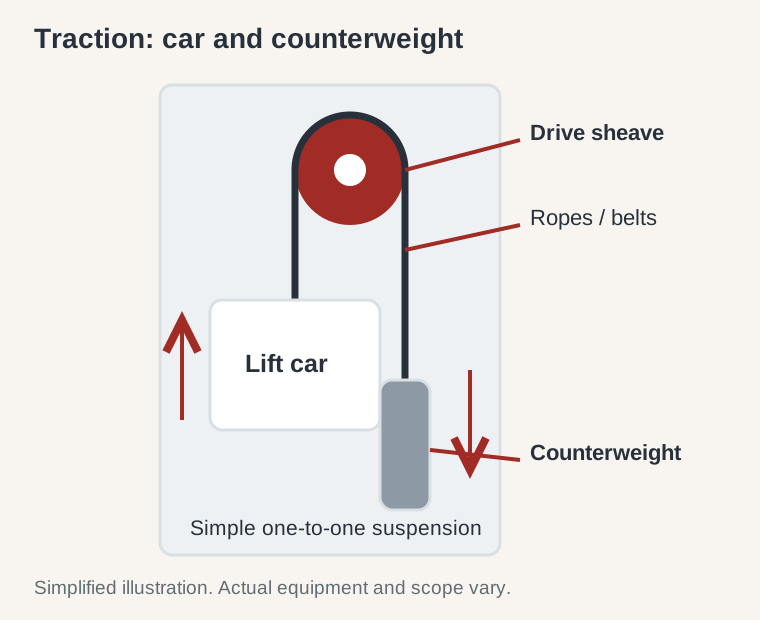
A traction lift moves its car using suspension ropes or belts passing over a driven sheave. The sheave is a grooved wheel. Grip between the suspension material and the sheave transfers the drive's movement to the car.
The diagram shows a simple one-to-one arrangement. Real installations may use additional pulleys and different suspension layouts, so it should not be used to identify every part in your building.
What does the counterweight do?
A counterweight balances part of the moving load. In the simplified arrangement shown, the car and counterweight move in opposite directions. The drive moves the system rather than lifting the full car load without a balancing weight on every journey.
This does not mean the counterweight exactly matches every passenger load. Its design and the lift's operating limits belong to the installed system and should not be inferred from a general illustration.
Geared and gearless arrangements
In a geared arrangement, gearing connects the motor's rotation to the drive sheave. In a gearless arrangement, the motor drives the sheave without that gearbox. Both use the traction principle.
These labels help describe equipment, but they do not establish its age, condition, service cost or suitability for an upgrade. Those questions require the equipment details and an assessment of the actual installation.
What controls the journey?
The controller, drive and position equipment coordinate starting, travel and stopping. Braking, doors and protective systems also form part of the installation. Knowing the lift uses traction does not tell you which of those systems caused a particular fault.
If a service report refers to suspension, a sheave, a drive or a brake, ask the provider to explain the finding and its effect in plain language. Request the specific recommended work rather than assuming all associated components need replacement.
Does a traction lift need a machine room?
Some traction lifts have machinery in a separate room. Others use a compact arrangement with machinery within the shaft and controls positioned to suit the design. These are commonly described as machine-room-less lifts.
The location changes access and building coordination. It does not remove the need for machinery, maintenance or an equipment-specific emergency arrangement.
What should building managers keep on file?
Keep available equipment identification, maintenance reports, outstanding recommendations and the current maintenance contract together. Record changes in operation from the normal passenger area, including the floor, time and any displayed message.
Do not enter a shaft or machinery space to photograph components, check ropes or investigate a noise. If the lift is behaving unexpectedly, describe the symptoms to the responsible provider and follow its instructions about continued use.
For upgrade discussions, ask which existing components would be retained, which would change and what further checks are required. A drive replacement, a controller upgrade and full modernisation are different scopes, even when they concern the same traction lift.